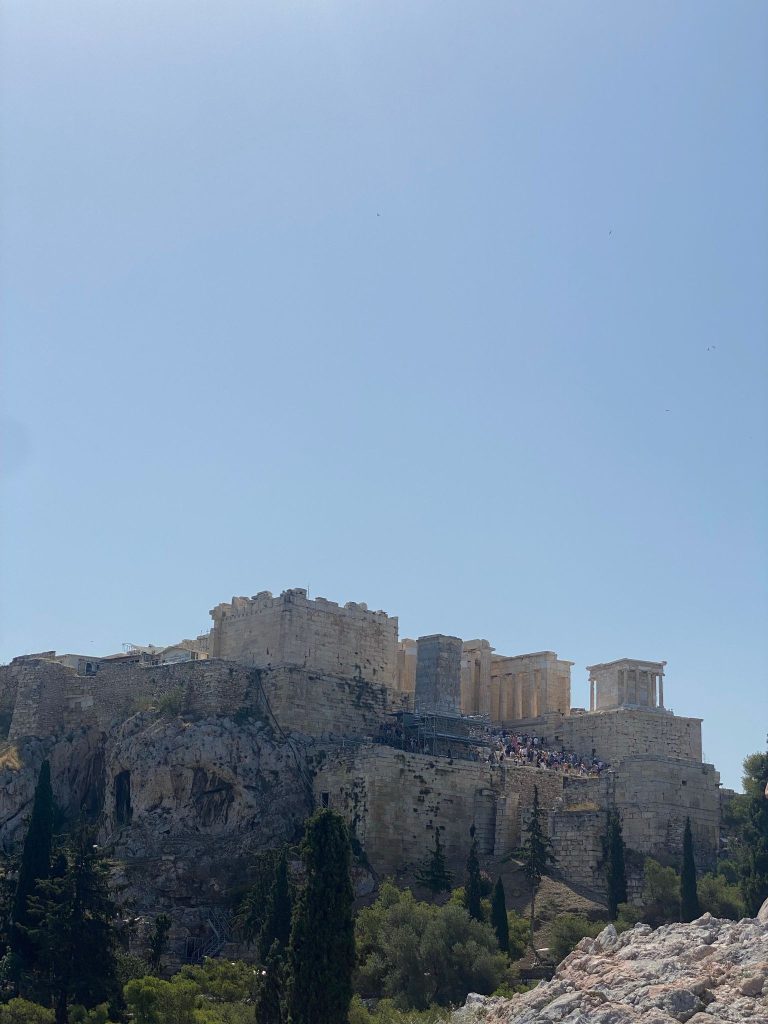
Athens wasn’t just something we saw after dark. My family and I also took time to explore it during the day, and one of those daytime trips took us to the Acropolis, the same ground where the great minds of Athens once walked and taught. I remember standing there, looking out over the whole city below us. Rows and rows of small concrete apartment buildings seemed to jut out of the ground and hills in every direction, packed close together as far as I could see. The sun was hitting their windows just right, and for a moment, the whole city looked like it was covered in tiny gems.
Right behind us stood the Parthenon, the great temple built for the goddess Athena, rising above everything like it had been watching over Athens for thousands of years. The Greeks didn’t just build beautiful temples here. They built ideas that still shape how we think today.
Just a short walk from that same hill, men like Socrates, Plato, and Aristotle spent their days asking questions, teaching students, and arguing about truth, justice, and how to live a good life. Athens even sentenced one of them to death for it.
These are the stories of the great minds of Athens… the teachers whose classrooms had no walls, and whose lessons never really ended.
Socrates: The Man Who Asked Too Many Questions
Socrates never wrote a single book. Everything we know about him comes from his students, especially Plato. He spent his days walking through the streets of Athens, stopping people in the market or outside the temples, and asking them questions. Simple ones at first. What is justice? Is courage something you’re born with? What does it mean to be good?
The questions never stayed simple for long. Socrates had a way of leading people through their own answers until they realized they didn’t actually know what they thought they knew. This became known as the Socratic method, and teachers still use it today.
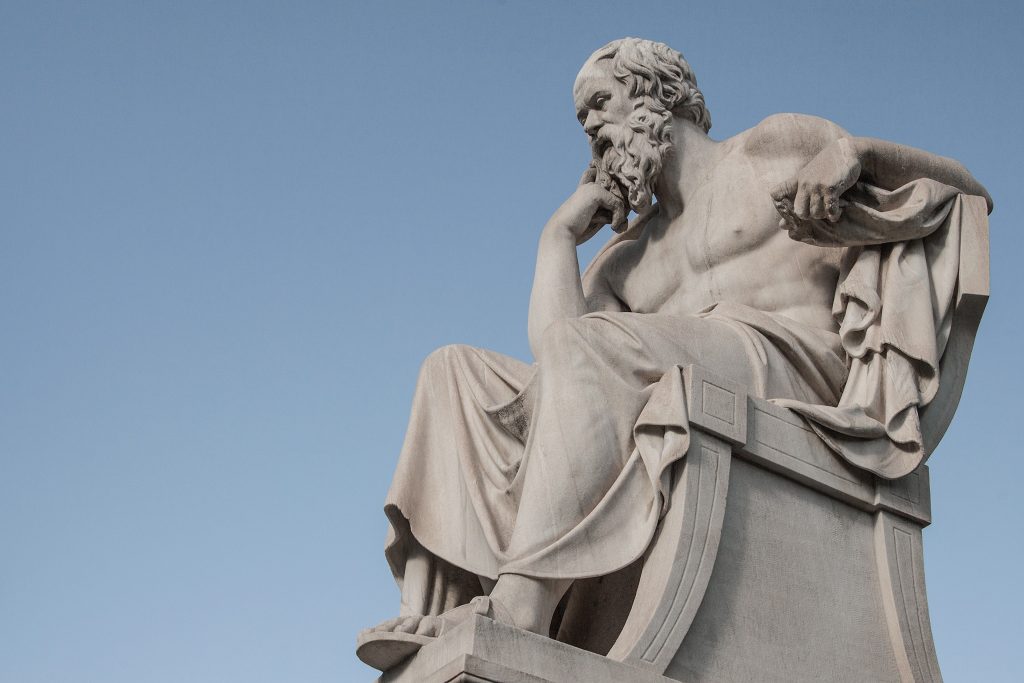
Not everyone appreciated being questioned in public. Some of Athens’ leaders saw him as a troublemaker, someone who stirred up doubt in young minds and disrespected the old ways. In 399 BC, Athens put Socrates on trial and sentenced him to death. Athens gave him the choice to escape, but he refused. He believed that living by his principles mattered more than living at all.
Plato: The Student Who Built a School
Plato was one of Socrates’ students, and he never forgot what he learned from him. After his teacher’s death, Plato wanted to make sure those ideas would live on, so he opened a school in Athens called the Academy. Many consider it the first university in the Western world.
At the Academy, Plato taught students to think deeply about big questions. What is a perfect society? What is real, and what only looks real? He wrote his ideas down as conversations, often putting Socrates himself in the role of the teacher within the pages. That’s part of why we know so much about Socrates today. Plato kept his voice alive in writing.
Aristotle: The Student Who Taught a King
One of Plato’s own students at the Academy was a young man named Aristotle. He spent nearly twenty years there, studying and eventually teaching alongside Plato. But Aristotle didn’t just want to talk about ideas. He wanted to study the world itself, from plants and animals to politics and the stars.
Aristotle eventually left Athens to take on a very different kind of student. He became the personal teacher of a young prince named Alexander, who would grow up to conquer much of the known world. We’ll get into that story in the next post. For now, it’s worth pausing on this one thread. A teacher taught a student, who taught another student, who taught a future king. Ideas passed hand to hand, and Athens was the place where it all began.
Solon: The Man Who Gave Power to the People
Before Socrates, before Plato, before Aristotle, there was Solon. He lived more than a hundred years earlier, and in many ways, he set the stage for everything that came after him.
Athens was struggling in his time. Wealthy families held all the power, and many ordinary citizens fell into deep debt, with some families even selling their own children into slavery just to survive. Athens asked Solon to fix the laws. Instead of protecting the wealthy, he canceled debts, freed the families who had fallen into slavery over debt, and gave ordinary citizens a voice in how the city was run.
Historians often point to Solon’s reforms as the first real steps toward democracy. He didn’t create a perfect system, and he knew it. But he opened a door that Athens never fully closed again.
Practical Greek for Learning and Wisdom
Here are a few practical Greek phrases connected to this post, if you want to carry a little bit of Athens’ love for learning with you.
Σοφία (Sophia) meaning wisdom
Ερώτηση (Erotisi) meaning question
Μαθητής (Mathitis) meaning student
Δάσκαλος (Daskalos) meaning teacher
Ελευθερία (Eleftheria) meaning freedom
The Legacy of Athens’ Great Minds
Standing on that hill above Athens, looking out over those sun soaked rooftops, it’s hard to imagine that the streets below once held the great minds of Athens deep in conversation, working through some of the most important ideas in human history. Socrates asking questions in the marketplace. Plato writing them down for the world to keep. Aristotle carrying them forward to teach a future king. And Solon, generations earlier, giving ordinary people a reason to believe their voice mattered.
Athens didn’t just build temples that still stand today. It built ways of thinking that still stand too.
Want to keep a few practical Greek phrases with you the next time you travel? Here’s a free way to get started.
Get your FREE Greek Phrase Guide eBook.
Practical Greek Phrases for travelers who want to speak the language.
Enter your email address to receive your free eBook.
Follow us on TikTok, Threads and Instagram @speakgreek for daily tips!
Leave a Reply