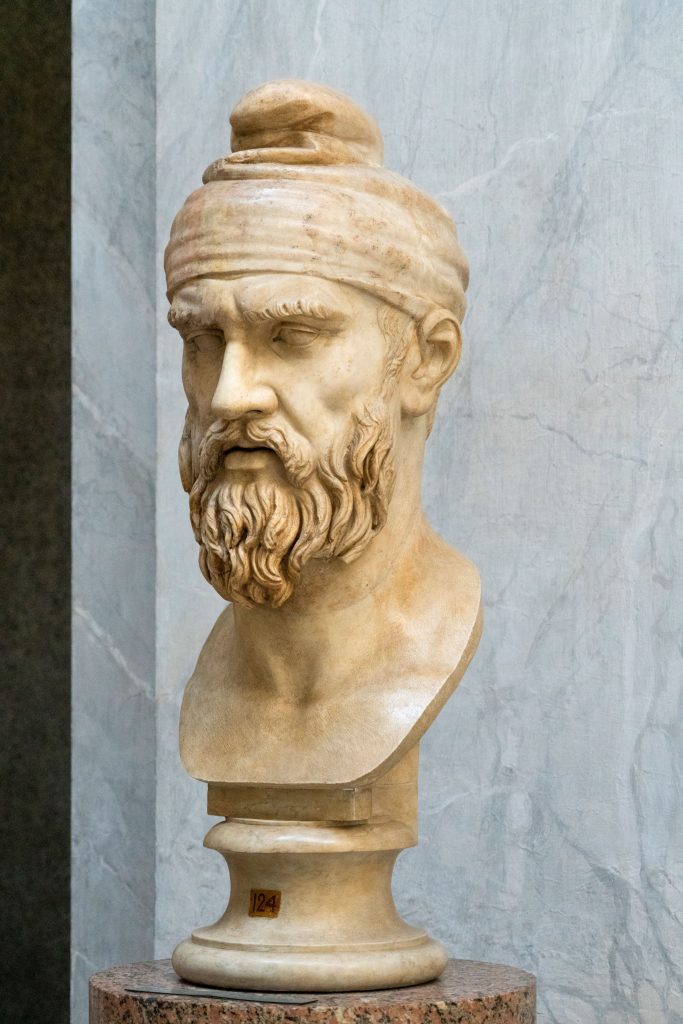
From Myth Into History
We left Athens standing at the edge of legend, a city named after a goddess, a hero who never quite came home the same. But at some point, myth gives way to something you can actually stand inside and touch. That is where this story picks up, with the Persian Wars and the rise of Pericles.
Have you ever stood somewhere and felt like you were standing on top of a history, layers of it, stacked under your feet without you even realizing? That is Athens.
The Athens we walked through was not only built on stories about gods. It was built by real people, making real decisions, in a city that had survived something that very nearly erased it.
The Wars That Almost Ended Athens
Twice, Persia came to Greece
The first time, in 490 BC, the Persian army landed at Marathon, a plain roughly 25 miles northeast of Athens. The Athenians, badly outnumbered, marched out to meet them anyway rather than wait behind their walls. They won, decisively, and legend says a runner carried news of the victory back to Athens on foot, collapsing after delivering the message. Whether that particular story is true or not, it gave the modern marathon its name and its distance.
Ever run a 5K and felt like your legs might give out? Now imagine running 26 miles in armor, after a battle, just to deliver one sentence.
Ten years later, Persia came back, this time with a force large enough that Athens itself could not be held. The city was evacuated. As a result, its people watched from ships and nearby islands as Athens burned.
But the war was not over. At Salamis, in the narrow straits near the city, the outnumbered Greek navy lured the massive Persian fleet into tight waters. There, its size became a disadvantage instead of a strength. The Greek ships, smaller and faster, tore the Persian fleet apart. It was one of the most consequential naval battles in ancient history, and it broke Persia’s momentum for good.
Athens had been burned to the ground and had beaten back an empire anyway.
Pericles and the City Rebuilt
Out of that survival came something unexpected: a golden age.
What would you do with a city that had just watched itself burn? Most people would rebuild the walls first. Athens rebuilt its mind.
Pericles, an Athenian statesman, rose to prominence in the decades after the wars and became the dominant voice in the city for nearly 30 years. Under his leadership, Athens did not just rebuild, it transformed.
This was the Athens that built the Parthenon we walked past in the last post. It was funded in part by tribute from other Greek city-states that had banded together against Persia and never quite stopped paying afterward.
It was the Athens of great tragedians writing plays still performed today. It was Athens where philosophy, as we had come to recognize, started to take shape in public squares and courtyards.
Pericles himself gave a speech, recorded by the historian Thucydides, honoring Athenian soldiers who had died in battle. In it, he described something Athens was unusually proud of: a system of government where power did not belong to one family or one class. At least among free male citizens, it belonged to the people themselves.
Who Was Pericles: The Statesman and General
A statesman is more than just a politician. It is someone who leads with vision, who cares about the long term health of their city, not just winning the next vote.
Pericles was exactly that. He was elected as a general almost every single year for nearly three decades, and the people of Athens trusted him again and again with that kind of power.
He earned that trust.
Under his leadership, Athens became the cultural capital of the entire region.
Artists, philosophers, and playwrights all gathered there, drawn to a city that valued ideas as much as it valued strength.
Pericles pushed for paid public service, so ordinary citizens, not just the wealthy, could serve on juries and hold office. As a result, that single decision opened the door for regular people to actually shape the laws they lived under.
Athens did not just follow the trends of the ancient world. Under Pericles, it set them.
Funding a Golden Age
Much of that cultural flourishing had a price tag, and Pericles found a controversial way to pay it.
Athens led an alliance called the Delian League, originally formed so member city-states could pool resources for mutual defense against Persia. Instead, Pericles redirected a large share of that shared treasury toward building projects in Athens itself, the Parthenon among them.
Some of Athens’ allies were furious. They felt their contributions had been quietly repurposed into monuments for a city that was not even theirs.
Pericles defended the choice, arguing that Athens had already done its part defending the region, and that beauty and permanence were worth investing in too.
Whether that reasoning was a noble vision or a convenient justification, it is still debated by historians today.
Either way, without that decision, the Parthenon as we know it might never have existed.
Democracy Born in the Agora
That system had a name: demokratia. Rule by the people.
It was not born in a palace or a temple.
It was born in the Agora, the open marketplace and civic square at the heart of Athens. That is the same place where the Temple of Hephaestus, the Theseion we mentioned back in Blog 16, still stands almost perfectly intact today.
Picture your local farmers market, but instead of buying tomatoes, the people around you are voting on actual laws. That was Tuesday in ancient Athens.
In the Agora, citizens gathered to vote directly on laws, debate policy, and even vote to exile a citizen they felt had grown too powerful, a practice called ostracism.
The Pottery Ballot
Here is the detail that stops most people cold: the ballots for ostracism were not paper, or wood, or anything official-looking at all.
They were broken pieces of old pottery, whatever was lying around. Then, citizens would scratch the name of the person they wanted gone right into the shard, and drop it in a pile.
If enough shards named the same person, that person had ten days to leave the city, for ten years. No trial, no appeal, just enough broken pottery with the same name on it.
Imagine your neighbors deciding, over a stack of broken plates, that you had to leave your own hometown for a decade.
It excluded women, enslaved people, and non-citizens entirely, and it was messy, loud, and often unfair by modern standards.
But it was also something genuinely new: the idea that ordinary people, gathered together, could govern themselves.
Standing in that same square today, it is strange to think that the word so many modern governments still claim for themselves started right there. It began in a crowded marketplace, in a city that had just watched itself burn.
When the Golden Age Began to Crack
The same confidence and ambition that built the Parthenon also pulled Athens into war.
Sparta, watching Athens grow wealthier and more powerful through the Delian League, saw a rival it could no longer ignore.
In 431 BC, tensions boiled over into full scale conflict, the Peloponnesian War, a war that would drag on for nearly three decades and reshape Greece for good.
Pericles did not live to see how it ended. Early in the war, a devastating plague swept through Athens, packed tightly behind the very walls Pericles had convinced citizens to retreat inside for safety.
He died from it in 429 BC, just two years into a war he had helped bring about.
There is a hard irony in that. The same leader who funded Athens’ golden age, its temples, its art, its democracy in the Agora, also steered the city into war. That same war would eventually unravel much of what he had built.
Eventually, Athens would go on to lose the Peloponnesian War decades later, and with that loss, its golden age never fully returned.
Closing Thought
Standing in the Agora today, it is hard to imagine that this quiet, sun-worn square once held the full weight of a civilization deciding its own fate.
Athens survived Persia, then rebuilt itself into something the world had never quite seen before. It became a city where ordinary citizens voted on their own laws, where art and philosophy were not luxuries but a way of life. A broken piece of pottery could even send a powerful man into exile.
Pericles stood at the center of all of it, the statesman who helped Athens become that kind of place. He was also the same leader whose ambitions helped set in motion the war that would eventually bring it all crashing down.
Greatness and downfall, it turns out, often grow from the very same roots. Pride.
That stack of broken pottery ballots is long gone now. But the idea behind it, that ordinary people deserve a say in their own future, never really left. It is still here, in every vote cast, every voice raised, every citizen who shows up believing their say matters.
One Last Memory
I remember stopping in the Plaka to eat that same trip, not thinking about pride or empires or broken pottery ballots.
I was thinking about my eyes, which had turned into a mess of thick, yellow, gooey pink eye so bad my spouse took me to a doctor the next day.
We had just come from the Temple of Hephaestus, where statue after statue stood in white marble or stone, most of them missing their noses, worn away by centuries of time and weather.
Ancient Athens fell because of the weight of its own greatness. I was just trying to make it through lunch with a straight face.
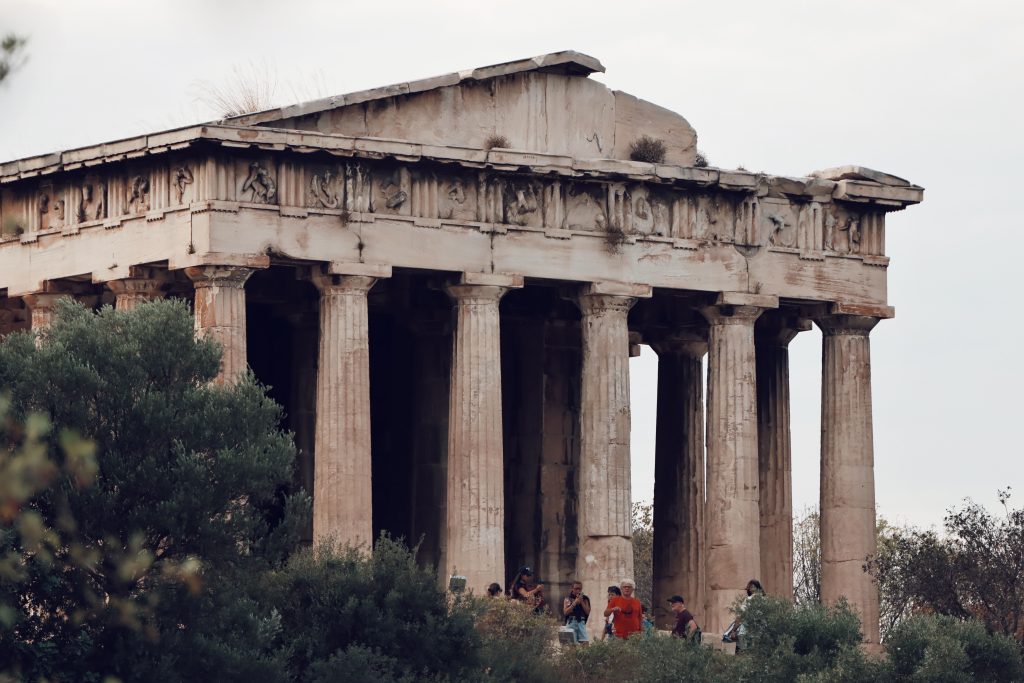
Somehow, standing in a place with that much history, even that small, uncomfortable moment felt like it belonged there too, proof that real life, messy and unglamorous, has always walked right alongside the myths.
Greek words for this journey:
| English | Greek | Sounds Like |
|---|---|---|
| War | Πόλεμος | PO-le-mos |
| Victory | Νίκη | NEE-ki |
| Democracy | Δημοκρατία | thi-mo-kra-TEE-a |
| People | Λαός | la-OS |
| Citizen | Πολίτης | po-LEE-tis |
| Vote | Ψήφος | PSEE-fos |
Get your FREE Greek Phrase Guide eBook.
Practical Greek Phrases for travelers who want to speak the language.
Enter your email address to receive your free eBook.
Follow us on TikTok, Threads and Instagram @speakgreek.app for daily tips!
Leave a Reply