The Arrival
Welcome back to this Athens Greece travel blog, picking up right where we left off leaving Thessaloniki. Our Olympic Airways flight touched down in Athens around 10:30 on a Tuesday morning, at Ellinikon International Airport, also known as Hellenikon. The village of Ellinikon gave the airport its name, and that village is now a coastal suburb south of the city. Our taxi dropped us in downtown Athens, and that’s where my Greek lessons started in earnest.
A Lesson in Dialects
My instructor began at once telling me about the dialects of Greece. Who knew there had been more than one? I certainly didn’t.
Attic was spoken in Athens itself, the dialect that shifted many alpha sounds to eta sounds, and the one used for the great philosophy and drama Athens became known for. Ionic developed along the coast of Asia Minor, the Cycladic islands, and Euboea, closely related to Attic. Doric belonged to the Spartans of Sparti, as well as Crete, parts of the Aegean islands like Rhodes, and even parts of southern Italy. This dialect held onto the long a sound, so the word for mother stayed mater instead of becoming meter as it did in Attic. Meanwhile, Aeolic took root in Boeotia near Athens, in Thessaly, and on the island of Lesbos off the coast of Asia Minor.
More on that later. By then it was 11:45, the sun was climbing, and all we wanted was something cold to drink and a place to stay for the week.
The Heat, the Wine, and a Scare
By Thursday we knew it was too hot to be out between 2:00 and 5:00. We started taking naps too, and they were refreshing. We met some of his friends in the park, and they were drinking wine instead of water. That was a question I held onto and tucked away, because I needed to know what was wrong with the water.
On our way back to the hotel, I was as drunk as I could be. I hadn’t had the chance to ask my instructor about the water yet, so every time they passed him a glass of wine, I drank it instead. He had already survived two serious heart attacks, and I feared for his life. He was eating pâté and hot peppers and drinking wine, and the heat outside made all of it worse. I knew this wasn’t something he was supposed to do, and it frightened me. My Greek was still very limited, and I had a young child to care for, along with myself and him.
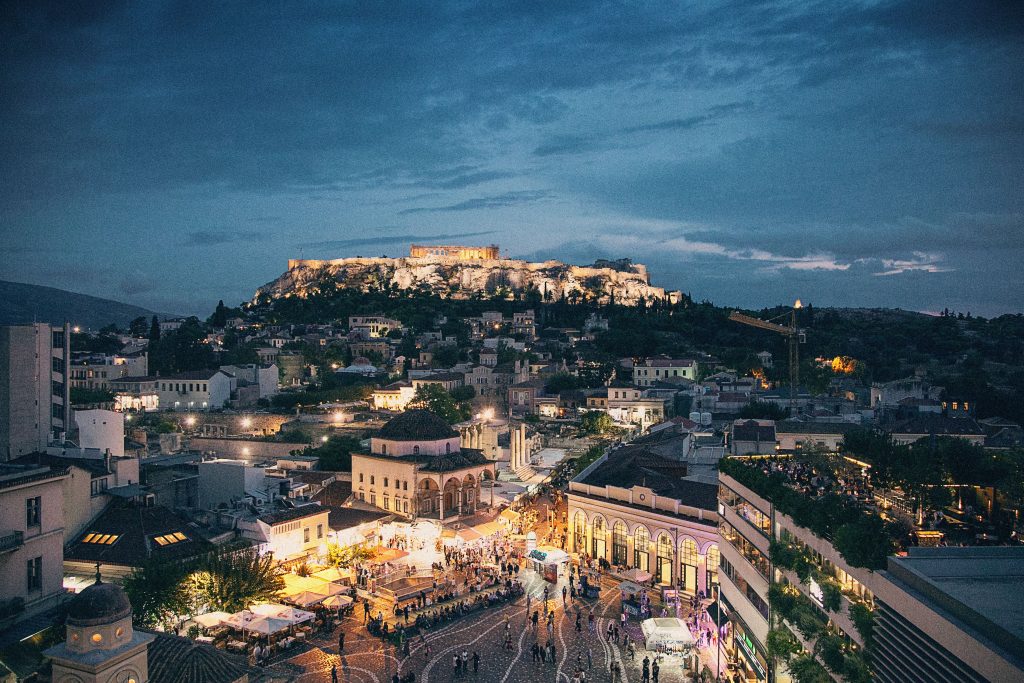
An Athens Greece Travel Blog Seen by Streetlight
The heat pushed us into a rhythm of streetlight travel. Buses idled past midnight, taxi windows stayed down, and Athens appeared and disappeared between buildings like something we weren’t quite sure we’d really seen. I don’t remember Athens the way I remember other places, in full daylight detail. Instead, I remember it in fragments: floodlit marble on a hillside, the hush of a city that was, impossibly, once ruled by a goddess.
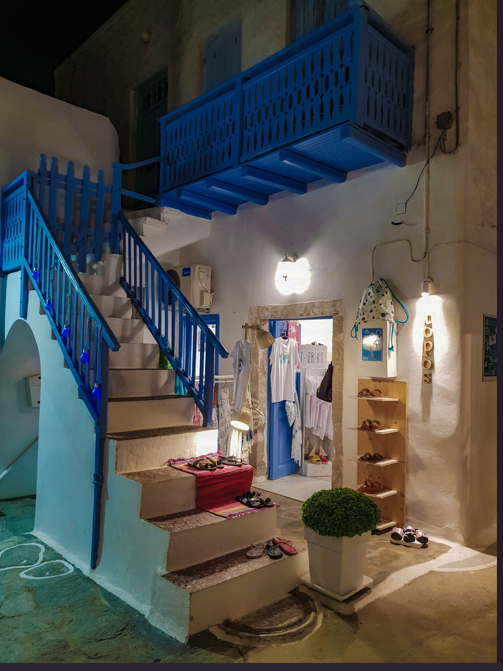
That’s the strange magic of writing an Athens Greece travel blog when your own memories are incomplete. I’ve given you what I did remember. Now I’ll tell you what was there, whether we saw it or not, the stories that were already old when the marble was new.
A City Named by a Goddess
One thing this Athens Greece travel blog keeps coming back to is how myth and geography overlap. Long before Athens became a capital, before it was even fully a city, it was a prize.
Two gods wanted it: Athena, goddess of wisdom, and Poseidon, god of the sea. Rather than fight over the rocky hill that would become the Acropolis, they agreed to a contest. Each would offer the people a gift, and the people would choose.
Poseidon struck the rock with his trident, and a spring burst forth. The people rushed toward it, then recoiled, because the water was salt, useless for drinking or growing anything. Athena’s gift was quieter. She planted an olive tree, offering wood for building, oil for cooking and light, and fruit to eat. The people chose Athena, and the city took her name.
If you climbed the Acropolis, you would have passed the Erechtheion, the strange, asymmetrical temple built specifically to honor this contest. A mark in the rock inside its precinct is said, whether by faith or tourism or both, to be Poseidon’s trident strike. Nearby, an olive tree grows where Athena’s is said to have stood. Whether it’s the same soil that mattered thirty centuries ago hardly matters. The city still keeps the story alive in stone and root.
A Pantheon of Names
Athena and Poseidon didn’t compete for the city in isolation. They were two of the twelve gods the Greeks called the Olympians, the ruling family of deities said to live atop Mount Olympus. Zeus, king of the gods and god of the sky, was Athena’s father. Hera, his wife, ruled over marriage and family. Apollo governed the sun, music, and prophecy, while his twin sister Artemis ruled the hunt and the moon. Hermes, quick and clever, carried messages between gods and mortals. Aphrodite embodied love and beauty, and Ares, her opposite, embodied war.
How Athena Was Born
History has it…Zeus was said to have swallowed Athena’s mother whole after a prophecy warned her child would surpass him, and Hephaestus later split his skull open with an axe, the strange, violent circumstance under which Athena was born, fully grown and armored.
d at the center of it all, but the Greek pantheon didn’t stop there. Beyond the twelve, the Greeks named hundreds of other gods, minor deities, and spirits: gods of rivers, winds, dawn, sleep, the underworld, individual mountains and springs. Some estimates put the total number of named Greek deities in the hundreds, a whole invisible population layered over the visible world, each with a role, a temperament, and a story.
Standing on a hill in Athens, it’s worth remembering that the contest between Athena and Poseidon wasn’t just two gods arguing. They were members of a much larger, and stranger family, deciding, for one city at least, who would be remembered first.
Where the City Sits
Looking out over Athens from any hill, you notice something strange for a European capital: there’s no dramatic skyline. No sudden towers break the horizon. Instead, the city spreads out in a wide, even sea of low buildings, block after block, almost the same height, stretching all the way to the mountains ringing the basin. It looks less like a city that was planned and more like a city that grew, one small deal at a time. In a way, it was.
These buildings share a name: polykatoikia, meaning “many residences.” They’re the plain, balconied apartment blocks that make up most of Athens, usually five or six stories, concrete, functional, unremarkable on their own. Still, the way they came to exist is one of the more interesting stories in the city’s modern history.
How Antiparochi Built a City
Athens grew fast after the Second World War and the civil war that followed it. People poured in from the countryside looking for work, and the city needed housing quickly, without much public money to build it. A private arrangement called antiparochi, meaning “in exchange,” filled the gap. A family that owned a small house or a plot of land would hand it over to a builder. In return, instead of being paid in cash, the family would receive several finished apartments in the new building once it went up, sometimes enough to live in one and rent out the rest.
No grand city planning office decided how Athens should look. Instead, thousands of individual landowners made thousands of individual bargains, and the polykatoikia system built the city one small trade at a time. That’s why so much of Athens has that same steady rhythm: similar heights, similar concrete, similar balconies looking out over the next building’s balconies. It wasn’t designed to look uniform. It just happened that way, deal by deal, family by family, across a few fast decades.
If you looked up from a taxi window at midnight the way we did, you were probably looking at someone’s grandmother’s old house, traded away years ago for four walls and a balcony of her own.
Stones That Remember the Myth
The Parthenon wasn’t just a temple to Athena. It was a myth carved into architecture, meant to be read the way we’d read a book.
The east pediment, above where visitors would have entered, depicted the birth of Athena herself, springing fully grown and armored from the head of Zeus. The west pediment, facing the city she would come to name, showed the contest itself: Athena and Poseidon frozen mid-offering, the olive tree and the spring, the moment of choosing.
Time has worn away much of that sculpture, and museums far from the hill it was carved for hold what remains. Still, knowing what was once there changes how you look at even a broken, weathered ruin. It wasn’t decoration. It was the story of the city’s own beginning, placed where everyone who climbed that hill would have to look up and see it.
The Hero Who Never Came Home the Same
Athens’s myths aren’t only about gods. They’re about a hero too: Theseus, something like a founding king to a young country, except his story is far stranger than any founding king’s.
Crete once demanded a tribute from Athens: youths sent every so often to feed the Minotaur, a monster part man and part bull. The Athenians built a labyrinth to contain him because he was too dangerous to kill or set loose. Theseus volunteered to go, not as a victim but to end the tribute for good. In Crete, Ariadne, the king’s daughter, fell for him and gave him a spool of thread, a way to find his way back out of the labyrinth once the Minotaur was dead. Theseus killed the beast, followed the thread out, and sailed home.
A Homecoming That Wasn’t
The story doesn’t end cleanly. In some tales, Theseus abandoned Ariadne on an island on the way home. Worse, he forgot to change his ship’s sails from black to white, the signal he’d promised his father he’d raise if he survived. Watching from a cliff and seeing black sails, his father believed his son was dead and threw himself into the sea. That sea still carries his name: the Aegean.
Near the Ancient Agora stands a temple that has survived astonishingly intact, better preserved than almost anything else from ancient Athens: the Temple of Hephaestus, long nicknamed the Theseion after this hero. Its walls once carried scenes from his labors. It’s a strange kind of monument, built for a god of blacksmiths, yet remembered, at least in name, for a man whose heroism came bundled with grief he caused and grief he couldn’t outrun.
Greek Words for This Journey
| English | Greek | Sounds Like |
|---|---|---|
| Goddess | Θεά | The-A |
| Myth / Story | Μύθος | ME-thos |
| Olive tree | Ελιά | E-LIA |
| Building | Κτίριο | KTI-rio |
| Streetlight | Φανάρι | Fa-NA-ri |
| Apartment | Διαμέρισμα | Thia-ME-riz-ma |
Closing Thought
We never saw any of this by daylight. But maybe that’s fitting, in its own way. Athens has always been a city half in myth, half in stone, where you’re never entirely sure where the story ends and the history begins. That tension is what keeps this Athens Greece travel blog going, one post at a time.
Get your FREE Greek Phrase Guide eBook.
Practical Greek Phrases for travelers who want to speak the language.
Enter your email address to receive your free eBook.
Follow us on TikTok, Threads and Instagram @speakgreek for daily tips!
Leave a Reply