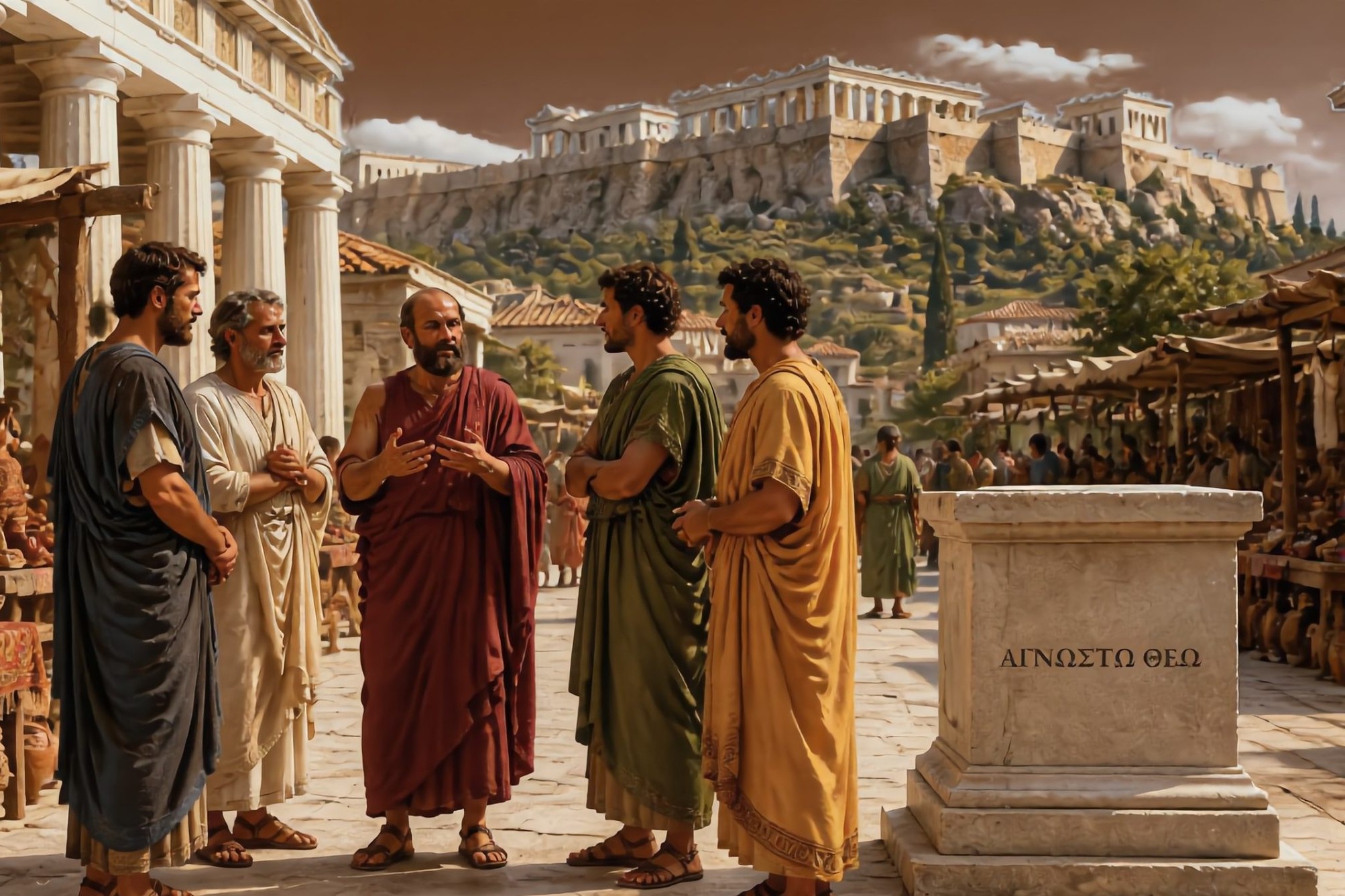
More history of the Apostle Paul in Greece… This time we find Paul in Athens, and he is all alone.
In our last blog, we followed Saul, the man who hunted down the followers of Jesus, as he became Paul, a man of peace. Now Paul has crossed the sea into Greece. He has been chased out of town after town, and sent off in a hurry. And now he is standing in Athens, one of the most famous cities in the world, with no friends beside him.
What happens next is one of the best known speeches in the whole Bible.
How Paul Ended Up in Athens
Paul did not plan to be alone in Athens. He had been teaching in Thessalonica, and trouble followed him.
“The brothers immediately sent Paul and Silas away by night to Beroea. When they arrived, they went into the Jewish synagogue.” (Acts 17:10, World English Bible)
And what happened in Beroea (also spelled Berea) is one of my favorite parts of the whole story.
“Now these were more noble than those in Thessalonica, in that they received the word with all readiness of mind, examining the Scriptures daily to see whether these things were so.” (Acts 17:11)
They checked it for themselves, every day. That is exactly the kind of reader we hope for. And it worked.
“Many of them therefore believed; also of the prominent Greek women, and not a few men.” (Acts 17:12)
But peace did not last.
“But when the Jews of Thessalonica had knowledge that the word of God was proclaimed by Paul at Beroea also, they came there likewise, agitating the multitudes.” (Acts 17:13)
So Paul had to leave again.
“Then the brothers immediately sent out Paul to go as far as the sea, and Silas and Timothy still stayed there.” (Acts 17:14)
“But those who escorted Paul brought him as far as Athens. Receiving a commandment to Silas and Timothy that they should come to him very quickly, they departed.” (Acts 17:15)
So Paul arrived in Athens by himself, with a message sent back for his friends to hurry and join him.
Paul in Athens: A City Full of Idols
Athens was no small town. Hundreds of years before Paul, it was the home of great thinkers and artists. By Paul’s day, Rome ruled Greece, but Athens was still proud of its past and still known for its learning.
While he waited, Paul walked the city. The Bible says:
“Now while Paul waited for them at Athens, his spirit was provoked (upset) within him as he saw the city full of idols.” (Acts 17:16)
He did not hide in his room. He went to work.
“So he reasoned in the synagogue with the Jews and the devout (very religious) persons, and in the marketplace every day with those who met him.” (Acts 17:17)
Every day. Paul talked with anyone who would listen.
Paul in Athens Meets the Thinkers
Then something happened that Paul may not have expected.
“Some of the Epicurean and Stoic philosophers also were conversing with him. Some said, ‘What does this babbler (someone who talks nonsense) want to say?’ Others said, ‘He seems to be advocating foreign deities (teaching about foreign gods),’ because he preached Jesus and the resurrection.” (Acts 17:18)
Who were these men? The Epicureans believed the gods were far away and did not care much about people. They said the goal of life was a calm and peaceful mind. The Stoics believed in living by reason and facing whatever came with courage.
Neither group had room for a man who said someone had been raised from the dead.
To the Areopagus
The thinkers were curious, though. They did not throw him out.
“They took hold of him, and brought him to the Areopagus, saying, ‘May we know what this new teaching is, which is spoken by you? For you bring certain strange things to our ears. We want to know therefore what these things mean.’” (Acts 17:19 to 20)
The Areopagus was a place and a council of Athens. Its name means “hill of Ares,” and Ares is the Greek god of war. The Romans called him Mars, which is why you may hear “Mars Hill.”
And the Bible tells us why they were so eager:
“Now all the Athenians and the strangers living there spent their time in nothing else, but either to tell or to hear some new thing.” (Acts 17:21)
Athens loved new ideas. Paul was about to give them the newest one of all.
Paul Stands Up in Athens
Try saying what Paul said 10 times, and see how far you get!
Ἄνδρες Ἀθηναῖοι, κατὰ πάντα ὡς δεισιδαιμονεστέρους ὑμᾶς θεωρῶ.
AHN dhres ah thee NEH ee, kah TAH PAHN dah ohs, dhee see dheh moh neh STEH roos, ee MAHS theh oh ROH.
(Men of Athens, I see that in every way you are very religious.)
He did not whisper, and he did not sneak away. He took his place in front of Athens’ best minds and began to speak.
“Paul stood in the middle of the Areopagus, and said, ‘You men of Athens, I perceive that you are very religious in all things.’” (Acts 17:22)
Notice how he starts. He doesn’t call them wrong. Instead, he says something true about them, that they care about worship. Paul starts where they are.
The Altar to an Unknown God
Then he told them what he had found while walking through their city.
“For as I passed along, and observed the objects of your worship, I found also an altar with this inscription (words carved in stone): ‘TO AN UNKNOWN GOD.’ What therefore you worship in ignorance, this I announce to you.” (Acts 17:23)
Why would Athens have an altar like that? The people there honored so many gods that they did not want to leave one out by mistake. If a god had been missed, this altar was a safety net.
Paul used their own altar as a doorway. He said, in plain terms, “The one you do not know about… let me tell you about him.”
The God Who Made Everything
And then Paul told them about this God.
“The God who made the world and all things in it, he, being Lord of heaven and earth, doesn’t dwell in temples made with hands, neither is he served by men’s hands, as though he needed anything, seeing he himself gives to all life and breath, and all things.” (Acts 17:24 to 25)
Think about where he was standing. Athens was full of beautiful temples. Paul was telling these people that the God who made the whole world does not live in a building people made.
Then he said something warm.
“He made from one blood every nation of men to dwell on all the surface of the earth, having determined appointed seasons, and the boundaries of their dwellings, that they should seek the Lord, if perhaps they might reach out for him and find him, though he is not far from each one of us.” (Acts 17:26 to 27)
Not far from each one of us. That is a line worth sitting with.
In Their Own Words
Now Paul did something clever. He quoted the Greek poets.
“‘For in him we live, and move, and have our being.’ As some of your own poets have said, ‘For we are also his offspring (children).’” (Acts 17:28)
He was speaking to Greeks, in Greek, using words their own writers had written. Paul showed these men he had listened, and that he was not afraid to meet them where they stood.
Then he made his point:
“Being then the offspring of God, we ought not to think that the Divine Nature is like gold, or silver, or stone, engraved by art and design of man.” (Acts 17:29)
Look around Athens, and you would see exactly those things everywhere… gold, silver, and stone, shaped into gods.
The Hard Part
Then Paul reached the part he knew would be difficult.
“The times of ignorance therefore God overlooked. But now he commands that all people everywhere should repent (turn around and change), because he has appointed a day in which he will judge the world in righteousness by the man whom he has ordained (chosen); of which he has given assurance (proof) to all men, in that he has raised him from the dead.” (Acts 17:30 to 31)
Raised from the dead. Remember what the Epicureans and Stoics had called him: a babbler who preached Jesus and the resurrection. Paul did not water it down. He said it plainly, to the smartest people in the city.
Mockers and Listeners
And just like today, people did not all react the same way.
“Now when they heard of the resurrection of the dead, some mocked; but others said, ‘We want to hear you again concerning this.’” (Acts 17:32)
“Thus Paul went out from among them.” (Acts 17:33)
Some laughed. Some wanted more. And Paul left.
Who Believed Paul in Athens
The Bible does not say a crowd followed Paul out. But it does say this:
“But certain men joined with him, and believed, among whom also was Dionysius the Areopagite, and a woman named Damaris, and others with them.” (Acts 17:34)
The name “Areopagite” suggests Dionysius was connected to the very council Paul had just addressed. And Damaris is a woman whose name we still know today, thousands of years later.
Not everyone mocked. Not everyone walked away. Paul arrived in Athens alone, and he left with people who listened and believed.
A Courageous Man
Paul had been run out of Thessalonica, chased from Beroea, and left alone in a city full of idols. And still he stood up in front of the sharpest minds in Greece and spoke plainly. That is the same man who once hunted Jesus’ followers.
Paul was a courageous man. He was an apostle to the nations of his time.
Coming soon: more on Paul, the apostle to the nations. His story isn’t over yet. He spent much more time in this great country, so stay tuned!
Sources
Acts 17:10 to 15, World English Bible (the road from Beroea to Athens)
Acts 17:16 to 34, World English Bible (Paul in Athens and the speech at the Areopagus)
Don’t just take my word for it, I encourage you to open the accounts and read for yourself.
Get your FREE Greek Phrase Guide eBook.
Practical Greek Phrases for travelers who want to speak the language.
Enter your email address to receive your free eBook.
Leave a Reply